
The closing moments of Star Wars Jedi: Survivor left a galaxy of questions swirling in the Force. While the game refined combat stances, deepened progression, and broadened enemy variety, its narrative felt like a mosaic assembled from too many tiles—Clone Wars echoes, High Republic remnants, and the ragged edge of the Galactic Civil War all competing for space. By the time the crew of the Mantis took in the orphaned Kata Akuna, the story had gathered itself into a knot, taut with potential but lacking the intimate focus that had made Cal Kestis’s journey in Fallen Order so gripping. Now, as the series peers into the chasm of a third chapter, the most compelling route forward demands not immediate continuation, but a deliberate, generous leap through time.
Kata Akuna stands at the center of that future, a force-sensitive child who watched her father plunge into the dark side and perish by Cal's blade. Adopted by Cal, Merrin, and Greez on the hidden planet Tanalorr, she represents both a promise and a peril. A direct sequel would likely mold her into Cal’s apprentice, a familiar silhouette under a Jedi’s hooded cloak. This master-learner dance—though proven in a thousand Star Wars tales—risks becoming as predictable as binary sunsets. It would cram a new confrontation into the already cramped timeframe of the Galactic Civil War, forcing Cal to duel the same Imperial shadows while coaxing a young mind toward the light. The dynamic would hum with echoes of Obi-Wan and Anakin, of Kanan and Ezra; noble, but thoroughly charted territory.
A time jump, however, cracks open possibilities like a geode struck by a master’s hammer. Imagine a decade or more passing in the sanctuary of Tanalorr, a hidden nebula where time flows differently than the galaxy’s wars. The Jedi series could then introduce a Cal Kestis weathered by years of quiet guardianship, his beard tracked with grey, his stance no longer that of a fugitive but of a keeper. This older Cal would need to reconcile the sanctuary he built with the inevitability of leaving it. Kata, now an adult, might no longer be a frightened child but a young woman whose Force sensitivity has ripened in isolation. Their bond could be twisted by stagnation, or shattered entirely if Kata’s curiosity—or resentment—drives her out of Tanalorr alone.
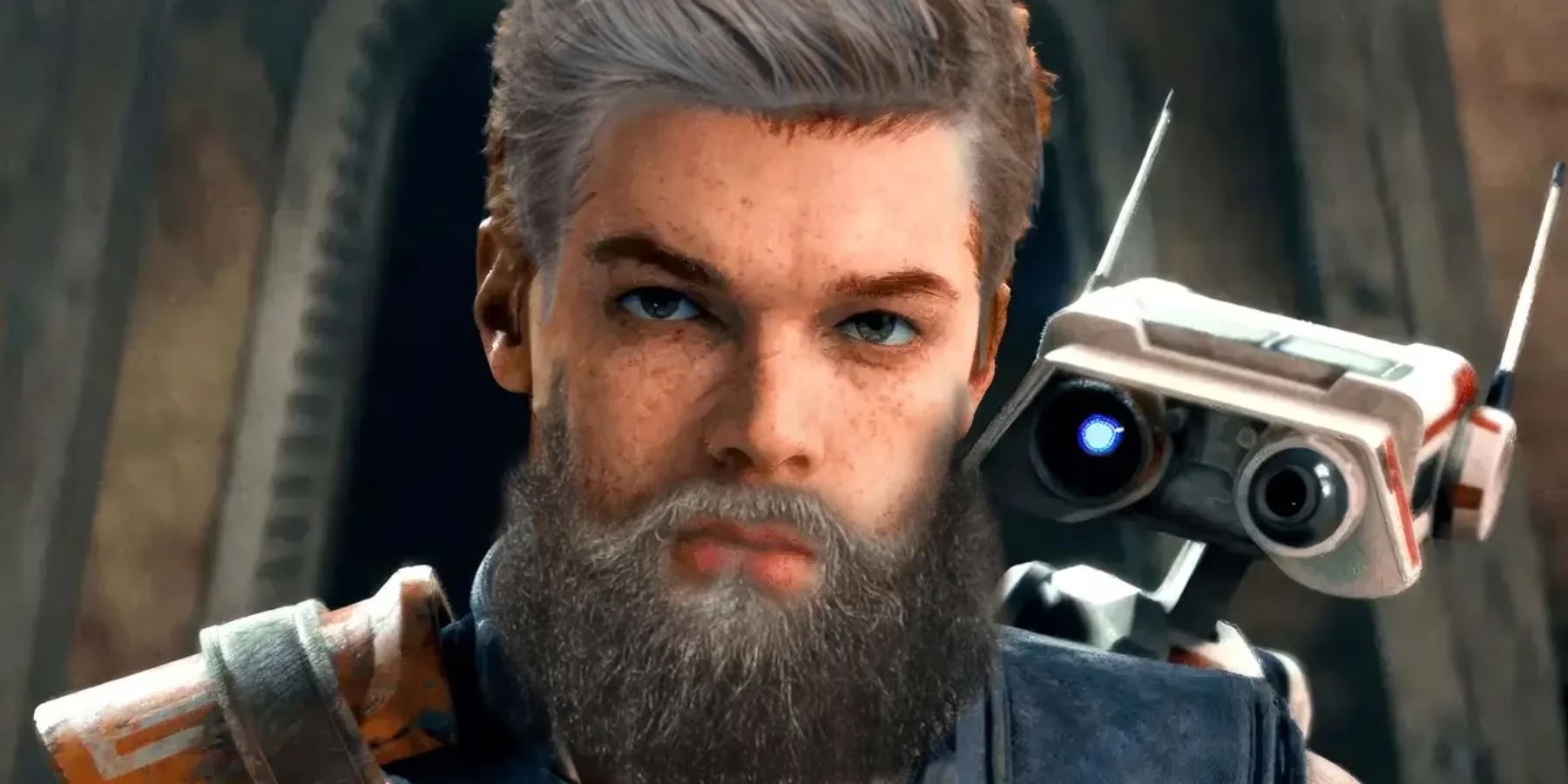
Such a leap would allow the story to shed the heavy robes of the established eras. The series has already rummaged through the Clone Wars, danced with the High Republic’s Nihil echoes, and fought shoulder-to-shoulder with Rebel cells. A years-long skip could deposit Cal into a fresh battlefield: perhaps the whispered rise of Grand Admiral Thrawn, a cold strategist whose influence spreads like frost across the galaxy’s edge. Or even further, into the simmering unrest of the First Order–Resistance war, where an aging Jedi might become both a symbol and a target. Freed from the canon’s tight webbing, Cal’s mission would cease to be a desperate survival run and instead become a deliberate, painful reckoning with what he has protected—and what he has lost.
The narrative enrichment runs deeper than era-switching. Consider the mentor-learner dynamic refracted through age. If Kata runs away from Tanalorr, Cal would be forced to track her not as a teacher shaping a pupil but as a father pursuing a stranger. His years of peace could have softened his instincts, while her isolation might have fermented a volatile independence—or a frightening draw toward the dark side. The chase would be less about lightsaber forms and more about the agonizing pull of family, a story where the Force acts as a tether neither can fully sever. Such a plot would invert the usual Star Wars rhythm by placing the mentor in the role of the pursuer and the apprentice in the role of the hunted, a reversal as rare as a black sun melting into a nebula.
Another avenue sees both Cal and a grown Kata leaving Tanalorr together, but as equals bearing the weight of decades. Their shared mission might involve rebuilding something akin to the Jedi Order, not through codified doctrine but through the ragged wisdom of survivors. This would move the series beyond the weary trope of the solitary hero and into a difficult, collaborative future where old wounds and new imperatives collide. The emotional geography of such a story would be less a straight path and more a braided river, twisting and merging around obstacles.
Critics might argue that a time jump discards the momentum Survivor built, leaving the Dark Side corruption of Bode and the hidden horrors of Tanalorr unexplored. But those threads need not be abandoned—they can be revisited as echoes, as scars that time has hardened rather than healed. Cal’s older self might still wrestle with the memory of having to kill a friend to save a child. Kata’s nightmares might be laced with her father’s final, corrupted form. The time jump wouldn’t erase history; it would let it marinate, granting it a complexity that immediate follow-up would struggle to achieve.
Pacing-wise, a leap also liberates the gameplay. An older Cal could possess evolved but diminished physicality—forcing a shift toward more deliberate, weighty combat that reflects his years. The slow burn of a time-shifted sequel would let the developers craft entirely new stances, new worlds outside the Empire’s grip, and a tone less frantic and more melancholic. The galaxy has changed while Tanalorr stood still; that dissonance would become the game’s emotional core, a quiet tremor beneath every ignited blade.
The Star Wars Jedi series stands at a crossroads, one path leading into familiar brush, the other into a misty expanse where the rules are unwritten. A time jump does not flee from the story so far—it carries it forward like a seed buried in deep soil, waiting for the right season. By embracing that patience, the sequel could deliver not just another chapter of Cal Kestis’s life, but a saga that bends the very way we think of Jedi in an era that never expected them to survive. The Force rewards the bold, and the boldest move Respawn could make now is to let time run its course.
Comments