
When Star Wars Jedi: Survivor launched in 2023, it promised an evolution of lightsaber combat that would build upon the foundation laid by its predecessor, Jedi: Fallen Order. Three years later, in 2026, the game's intricate stance system remains a benchmark for action-adventure titles, offering players a deeply personalized combat experience that feels less like a rigid skill tree and more like a fluid martial arts philosophy. Each of the five stances represents a distinct school of thought in Cal Kestis's journey from Padawan to Jedi Master, forcing players to make a critical choice: with only two stances equipable at any time, which combat philosophy will you carry into battle?
5. Double-Bladed Stance: The Whirling Dervish of Defense
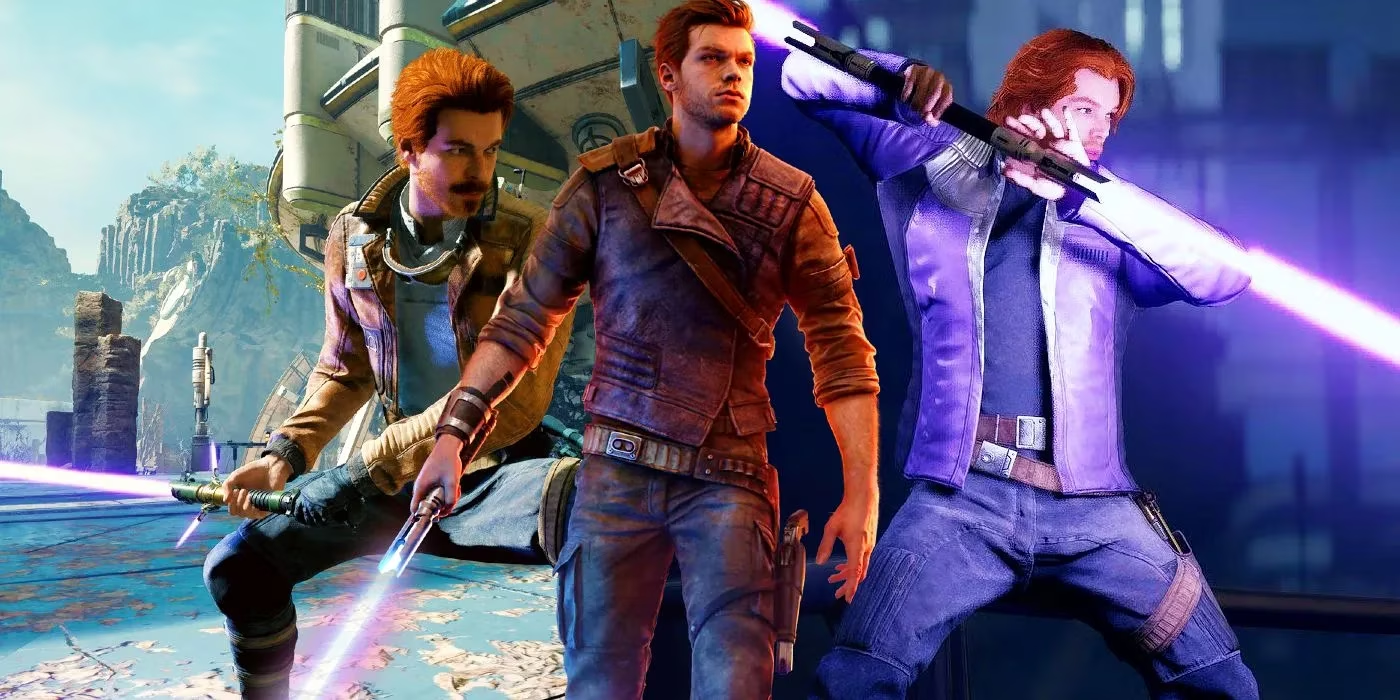
The Double-Bladed stance is one of the two starting options, a familiar friend to veterans of Fallen Order, yet refined like a well-honed blade. Its core identity is that of a defensive, crowd-control maestro. While its individual strikes lack the raw power of other forms, it compensates with unparalleled speed and a defensive guard that feels like a spinning energy shield. Against groups of standard enemies, it is devastatingly efficient, allowing Cal to move through mobs like a whirlwind through dry leaves. The upgraded abilities elevate this further; the Vortex Dive attack transforms Cal into a living buzzsaw, leaping forward with blades spinning in a move reminiscent of Darth Maul's iconic aggression. However, this stance's weakness is its specialized nature. Against singular, powerful bosses or armored foes, its attacks can feel like raindrops against durasteel—persistent but lacking the decisive impact needed to break through formidable defenses. It excels in its niche but requires a complementary stance for more versatile challenges.
4. Single Blade Stance: The Reliable Foundation
The Single Blade stance is the bedrock upon which Cal's skills are built. It is the quintessential middle ground, offering no extreme advantages but suffering from no glaring weaknesses. Its power, speed, and range are all perfectly average, making it the most balanced and reliable choice. For players navigating the story for the first time, it serves as a perfect training saber, allowing them to learn enemy patterns without being punished by a specialized stance's limitations. Its upgrades, like the Charged Throw that can eliminate mid-tier enemies in one hit, provide solid power spikes. In 2026, this stance is often seen as the comfortable, worn-in leather of lightsaber forms—it may not be the flashiest, but its dependability is unmatched, especially when facing unknown boss mechanics. It is the calm center in the storm of combat, a stance that asks for mastery of fundamentals over flashy technique.
3. Dual Wield Stance: The Glass Cannon's Ballet
Unlocked third in Cal's journey, the Dual Wield stance is the embodiment of aggressive finesse. It is Jedi: Survivor's premier glass cannon, trading all pretense of defense and range for blistering speed and high damage output. Wielding two sabers, Cal becomes a storm of scarlet plasma, but one misstep can lead to a quick defeat. What truly defines this stance is its unique mechanical depth: it is the only form where attack animations can be canceled. This adds a layer of high-risk, high-reward strategy that is as intricate as a master's chess game, allowing skilled players to feint, dodge, and flow between offense and defense seamlessly. Mastering this cancel is not just beneficial but essential for conquering the game's hardest difficulties in 2026. When fully upgraded, skills like Dancing Blades—where both sabers are thrown to ricochet between enemies—create moments of pure, visually spectacular chaos. This stance is not just about attacking; it's a perilous dance on a razor's edge.
2. Crossguard Stance: The Deliberate Juggernaut
The Crossguard stance, inspired by Kylo Ren's brutal design, is the last stance players unlock and represents a fundamental shift in combat philosophy. This is as close to a walking fortress as Cal gets. Abandoning the series' trademark acrobatics, this stance treats the lightsaber like a medieval broadsword—slow, heavy, and immensely powerful. Each swing is a committed, deliberate act that carries tremendous weight, both visually and in impact. The defense is superb, but the cost is speed, making Cal move with the deliberate pace of a tectonic plate shifting. This change in rhythm can be jarring but ultimately rewarding, fostering a more thoughtful, almost meditative approach to battle. Its skills are equally impactful: the Shockwave ability stuns groups of enemies, creating openings, while the Charged Reflection turns deflected blaster bolts into high-yield explosives. The Crossguard throw is the most powerful in the game, capable of cleaving through lined-up foes. This stance is for the patient warrior who believes the strongest defense is an overwhelming, unstoppable offense.
1. Blaster Stance: The Revolutionary Hybrid
In a universe defined by the elegant weapon of a more civilized age, the Blaster stance is a revolutionary, almost heretical, innovation. Introduced when Cal receives a blaster from Bode Akuna, this stance marries the iconic weapons of Star Wars into a singular, devastating combat style. It offers the greatest tactical range, allowing Cal to pick off enemies from a distance while still being capable of precise parries and strikes up close. The synergy with new Force powers, like Soaring Lift, makes it incredibly versatile and, in skilled hands, overwhelmingly powerful. The blaster's ammo regenerates through lightsaber hits, creating a beautiful loop of melee and ranged combat. The Quick Draw ability, which slows time for targeted shots, provides moments of supreme satisfaction. In 2026, this stance is celebrated not just for its effectiveness but for its unique narrative flavor—it feels like a signature style for Cal, a pragmatic survivor adapting the Jedi arts to his harsh reality. It is a seamless fusion of elegant fencing and gritty sci-fi warfare, earning its place as the most unique and powerful stance for many players.
Choosing Your Path: A Stance Comparison for 2026
| Stance | Playstyle | Best For | Key Weakness |
|---|---|---|---|
| Double-Bladed | Defensive Crowd-Control | Handling large groups of weak enemies | Low single-target damage |
| Single Blade | Balanced & Reliable | Learning the game, first playthroughs | Lacks specialization or "wow" factor |
| Dual Wield | High-Risk, High-Reward Aggression | Skilled players, high-difficulty runs | Very low defense, short range |
| Crossguard | Slow, Powerful Deliberation | Breaking defenses, patient players | Extremely slow, poor against fast enemies |
| Blaster | Versatile Hybrid Combat | Tactical players, mixing range and melee | Manages two resources (Force & ammo) |
Ultimately, the "best" stance in Star Wars Jedi: Survivor remains a deeply personal choice, a reflection of the player's own approach to the Force. The system's brilliance lies in how these five philosophies interact and complement each other. A player might pair the defensive whirlwind of the Double-Bladed stance with the precise, powerful strikes of the Crossguard, or combine the reliable Single Blade with the revolutionary flexibility of the Blaster. In 2026, this depth ensures that Cal Kestis's journey feels fresh and engaging, inviting players to continually rediscover the galaxy far, far away through the lens of a newly mastered combat form.
Comments