
I remember the first time my fingers danced across the board, those simple coins feeling heavier than any weapon I'd wielded against the gods. Just an hour into Flintlock: The Siege of Dawn, after the smoke of liberation had cleared and Baz's familiar grin welcomed me back, Sebo revealed itself. It wasn't a grand spectacle, but a quiet invitation—a puzzle whispered on worn wood. In a genre where every shadow holds a blade and every corridor an ambush, here was a different kind of battle. A battle of wits, of anticipation, played out with metallic pieces under a digital sky. It felt... personal. A secret rhythm in the heart of the chaos, a game within the game, asking not for my reflexes, but for my foresight. And oh, what a delightful, brain-tickling distraction it became from all that platforming peril.
The Deceptively Simple Board
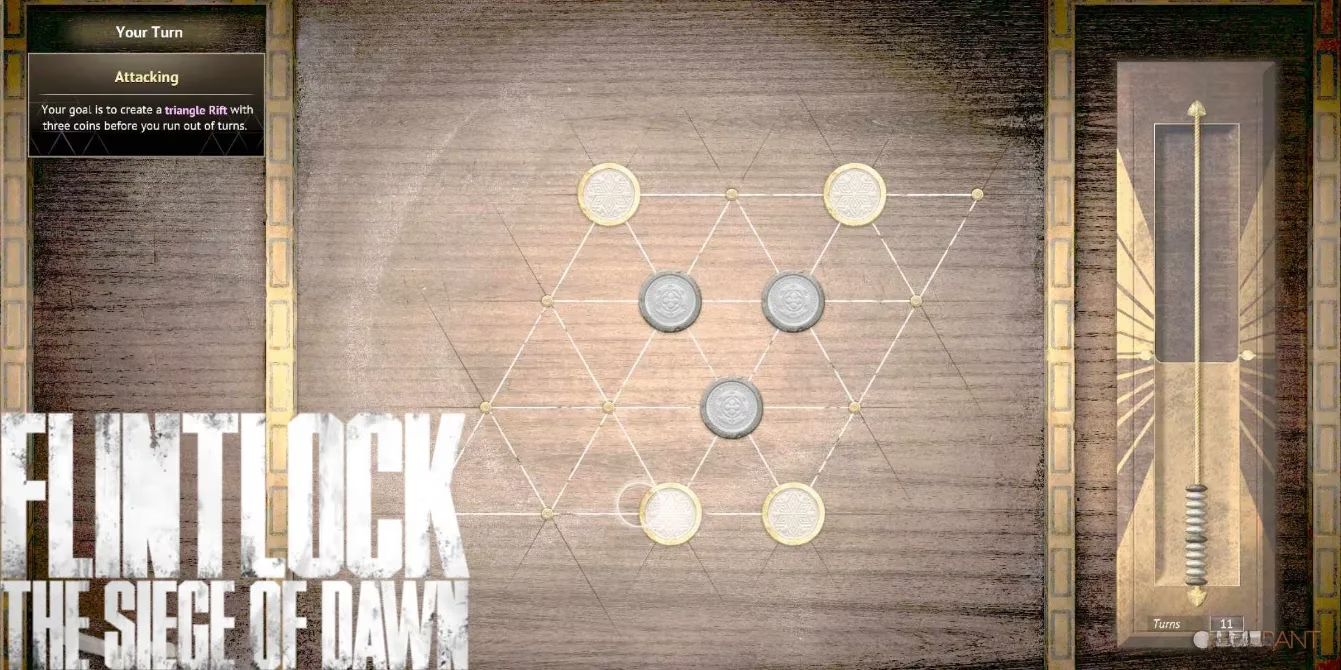
The rules, at first glance, seemed almost childishly straightforward. Move the coins. Form a triangle with three of your own in the first act. In the second, become the wall—prevent your opponent from doing the same for a handful of tense turns. Simple, right? Hah, talk about a classic case of "looks can be deceiving." That board transformed from a simple grid into a psychological landscape faster than you can say "checkmate." Each move felt like planting a flag, each empty space a question mark. The limited turns weren't just a timer; they were the very heartbeat of the game, a constant, gentle pressure behind my eyes. I'd spend minutes staring, tracing imaginary lines, playing out scenarios in my mind's theater before my hand even twitched toward a piece. It was chess, but distilled into something purer, more immediate.
When Coins Gave Us Wings
Just when I thought I had its measure, Sebo laughed and changed the rules. Not the official rules, mind you, but the tools of the trade. I met an opponent whose coin... glimmered differently. Then came the revelation: special abilities. A coin that could nudge an adversary's piece aside with a confident click. Another that could perform a sly, instantaneous swap with a neighboring foe. Man, these things were game-changers! Suddenly, the static board erupted with possibilities. That predictable opponent three spaces away? Not so safe anymore. My own backline? Potentially vulnerable to a sudden teleportation assault. These enchanted discs added layers of delicious complexity, ensuring no two matches ever played out the same. They were the wild cards, the narrative twists in our silent duel. Planning five moves ahead became a necessity, not a luxury, because you never knew when a coin might just decide to go for a stroll.
The Soul of Strategy: A Tapestry of Great Minigames
Playing Sebo, I couldn't help but feel the ghostly hands of other great minigames guiding my moves. It's part of a grand, unspoken tradition.
-
The Strategic Kinship: My mind kept drifting to the titans. Final Fantasy 7 Rebirth's Queen's Blood—oh, what a beast that was. Sebo and Queen's Blood, they're cousins in strategy. Both live and die by positioning. In Sebo, I'm always asking, "Where will they go?" and maneuvering to block or trap. In Queen's Blood, it was the same frantic, beautiful calculus of predicting card placements and cutting off lanes of power. Different canvases, same beautiful, brutal ballet of the mind.
-
The Guessing Game: Then there's Horizon Forbidden West's Machine Strike. Another kindred spirit! It shared that core, thrilling uncertainty. In Machine Strike, positioning on terrain was key, but so was the endless guesswork: "Is she moving her Ravager to the high ground or flanking with the Clawstrider?" Sebo distilled that same feeling into its purest form—a tense, silent dialogue of "I think you'll go here, so I'll go there."
-
The Whims of Fate: And let's not forget the Soulslike family outlier, Star Wars Jedi: Survivor's Holotactics. This one shared Sebo's soul in a different way—its random heart. In both, you could have the perfect strategy, the unbeatable formation... and then the AI would pull a move so brilliantly stupid it somehow worked, or the coin you needed just refused to land in the right spot. Sometimes, the opponent's logic felt less like code and more like ancient, inscrutable wisdom. Or just plain, infuriating luck. Gotta love it, right?
More Than a Game: The Reward of Repose
But Sebo wasn't just a clever pastime. Victory brought the sweet, tangible clink of Reputation—Flaintlock's lifeblood. That hard-earned currency funded my real journey: unlocking devastating new skills in the tree, forging sharper blades and sturdier armor, and yes, even buying a snazzy new outfit for the hell of it. The loop was perfect: challenge the mind in Sebo to empower the body in the siege. Sure, the randomized elements could sometimes feel like the board itself was conspiring against me, throwing up impossible configurations. But those moments of frustration made the victories sweeter, the solved puzzles more satisfying. It never felt like a chore, but a rewarding retreat. A place to let the adrenaline settle and let a different kind of intensity take hold.
So here I am, in 2026, looking back at the quiet revolution in a loud game. Sebo, in its elegant simplicity, carved out a space for thoughtful play in a world designed for reaction. It asked for patience in a genre of impulse, for strategy in a landscape of strength. It stood tall, not just as a fun diversion, but as a worthy contemporary to the minigame greats—a testament to the fact that sometimes, the deepest battles are fought not with guns and axes, but with silence, a wooden board, and a handful of coins that hold worlds of possibility within their cold, metallic circles. It was, in its own quiet way, a masterpiece of moments between the monsters.
Comments