
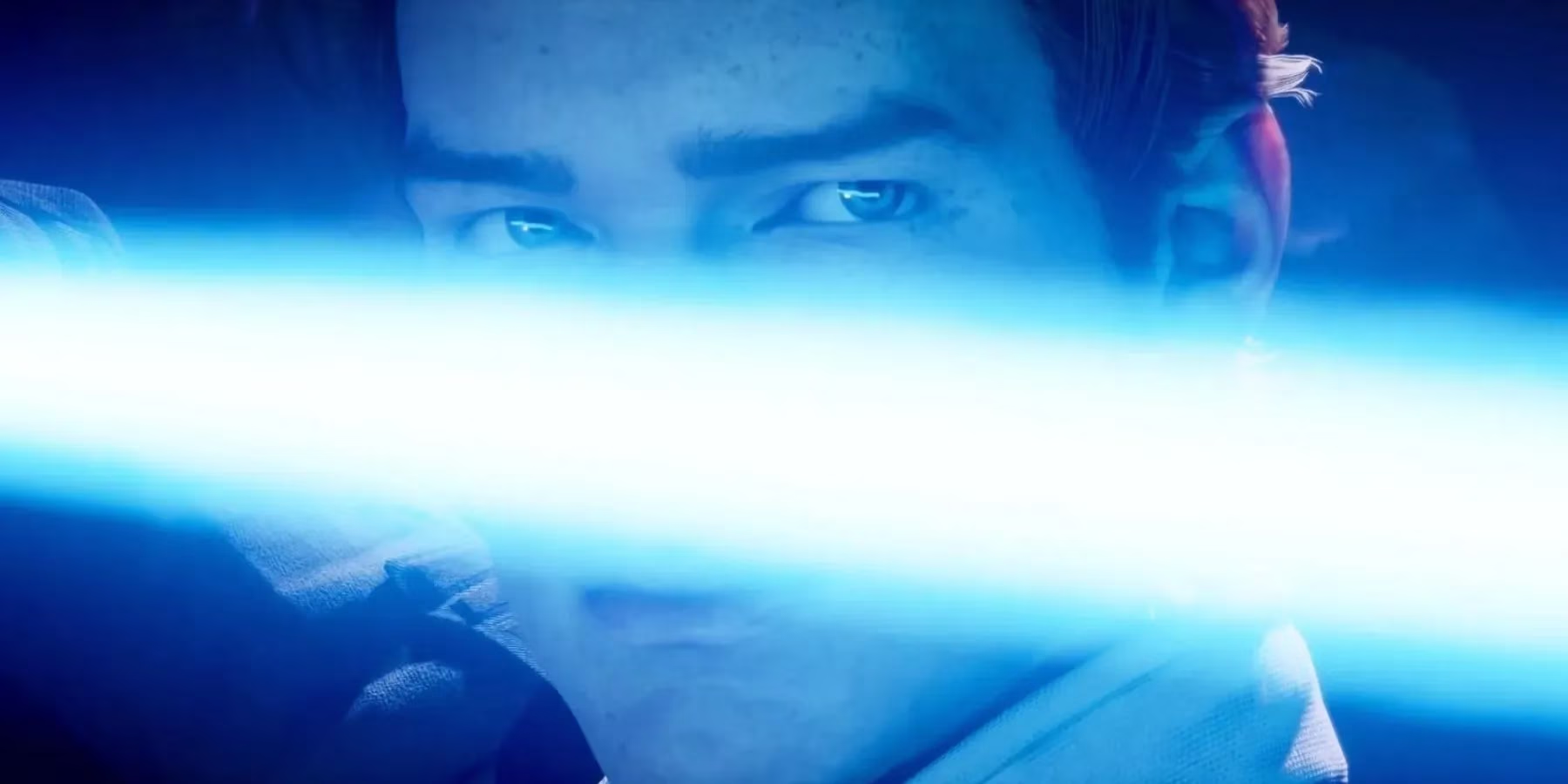
Four years have slipped by since I last guided Cal Kestis through the shattered landscapes of Star Wars Jedi: Survivor. As 2026 unfolds, whispers of a third installment stir the gaming air with electric anticipation. I still remember the first time I ignited a lightsaber in Fallen Order—that hum, the scorching glow, the sheer weight of Jedi fantasy made tangible. But as a seasoned player who has parried Purge Troopers and wall-run across countless chasms, I know that sequels demand reinvention. And after spending hundreds of hours with both games, a reckless, thrilling idea keeps haunting me: Respawn Entertainment should steal Cal's lightsaber away. Not for a fleeting tutorial sequence or a brief prison break, but for a long, punishing, and transformative stretch of the narrative. It sounds sacrilegious, I know. Yet it might be exactly what this hybrid Soulslike-action saga needs to evolve.
The dilemma is real. Traditional Soulslikes reset the board each entry—naked hero, zero souls, endless deaths. But the Star Wars Jedi franchise shoulders a heavier burden. It must deliver the methodical, punishing rhythm of a Soulslike while also honoring tight, cinematic storytelling and a protagonist who grows visibly stronger with every chapter. Survivor already iterated brilliantly on Fallen Order by introducing crossguard, blaster, and dual-wield stances alongside returning favorites. For a sequel, Respawn could dream up more styles—curved hilts, lightwhips, or refined versions of the five we've mastered. They deserve mountains of praise if they keep Cal from plunging into the dark side or wielding Force lightning. Yet adding more stances risks bloat. What if the true evolution lies not in what Cal holds, but in what he loses?
Both games already proved that stripping away the lightsaber at key moments creates unforgettable tension. I'll never forget Fallen Order's opening. As a Padawan hiding on Bracca, I had my weapon strapped to my back but dared not unclip it, choking on fear as Imperial machinery clanked around me. Only when Prauf's life bled out did instinct take over, the blade leaping to hand in a flash of righteous fury. Then Survivor twisted the formula: Cal deliberately handed his lightsaber to Senator Sejan as part of a staged capture, only to telekinetically yank it back once BD-1 sliced his cuffs. The game whispered, "You know what this weapon can do, but watch what happens without it." These were brilliant appetizers. But the only substantial course of disarmed gameplay came when the Haxion Brood snatched me to Ordo Eris. Trapped in that underground gladiator pit without my lightsaber, I felt utterly stripped. That sequence, however, was a scripted detour. A sequel could weave disempowerment into the core fabric.
Imagine a mid-game catastrophe—an ambush that leaves the lightsaber shattered or stolen by a new Imperial Inquisitor, a Grand Admiral Thrawn-esque tactician who understands that taking a Jedi's blade is psychological warfare. Cal would be forced to rely solely on his Force abilities and a blaster pistol. The combat loop would metamorphose. No more automatic deflections of crimson bolts; every incoming shot would demand a well-timed Force push, a desperate dodge, or a strategically spent block with a flimsy melee weapon scavenged from the environment. Parries would vanish, replaced by the need to wear enemies down through telekinetic slams, confusions, and the stun-and-shoot rhythm of the blaster. Players would have to balance a finite Force meter between offensive bursts and defensive survival, making every encounter feel like a high-stakes puzzle rather than a dance of laser swords. Resource management would become visceral. The blaster itself carries heavy narrative weight, gifted to Cal by Bode Akuna—a friend turned traitor whom Cal executed with that very weapon in front of Bode's daughter. Some players argue Cal should hurl that "inelegant weapon" away, corrupted by memory. But forcing him to clutch it for survival would be far more powerful, a constant reminder of the cost of his path. This guilt-soaked tool could even unlock dark, desperate upgrades reminiscent of Knights of the Old Republic II's influence system, without ever truly making Cal fall.
The series already planted seeds for this transformation. Cal's psychometry and Force slow matured across Survivor, and his connection with Merrin opened doors to Nightsister magick. A blaster-and-Force setup could feel like a western-set Jedi power fantasy—a lone ranger wielding terrain, confusion, and carefully aimed bolts instead of the familiar blade ballet. The environments would have to respond: more verticality, more cover, more opportunities to manipulate droids and wildlife into fighting for you. Co-op elements with Merrin or new companions could fill the close-quarters gap, letting you tag-team against Stormtroopers while you scramble for an opening.
| Game | Lightsaber Absence | Duration | Impact |
|---|---|---|---|
| Fallen Order (Bracca intro) | Cal hides his lightsaber to conceal identity | 15-20 minutes | Teaches stealth, builds tension, makes first ignition cathartic |
| Survivor (Coruscant heist) | Lightsaber given to Sejan, retrieved via Force | 10 minutes | Highlights Cal's cunning, reinforces Force mastery |
| Fallen Order (Ordo Eris prison) | Abducted, no lightsaber until escape | 30-40 minutes | Introduces improvisation, gladiatorial panic, but limited scope |
| Hypothetical third game | Extended loss (multiple hours) | A full story act | Complete combat paradigm shift, character development hub |
I can hear the purists grumbling already. Lightsaber combat is the franchise's sacred heart, and removing it for more than a gimmick could alienate the very fans who worship those custom hilt parts. But Jedi is a narrative-driven action-adventure first, and the best stories forge heroes through deprivation. Think of Metroid Prime 2: Echoes yanking Samus's upgrades, or The Legend of Zelda: Breath of the Wild shattering Master Sword's invincibility. Cal's growth has always mirrored his relationship with his weapon—from a scared teen concealing it under a poncho to a confident Knight parading it openly. Now it's time to test who he is without it. The third game could climax with the reforging of a new lightsaber, perhaps using a crystal purified from a dark source, making the return of the blade an earned, emotional crescendo rather than a default state.
Respawn has shown they understand the power of controlled disempowerment. Every wrench thrown into the player's toolbox in the first two games — a surprise probe droid, a malfunctioning BD-1 — intensified the journey. An extended lightsaber absence would be the ultimate wrench. It would force us, the players, to master the Force in ways we've only tasted, to rely on a blaster that symbolizes loss, and to find a new rhythm of combat that stretches the definition of what a Jedi game can be. By the time Cal finally wraps his fingers around a hilt again, the payoff would feel monumental. In a galaxy far, far away, sometimes the most powerful step forward is the one taken with empty hands.
This discussion is informed by OpenCritic, whose review aggregation often highlights how sequels succeed when they introduce meaningful mechanical friction rather than just piling on new options. For a third Star Wars Jedi entry, an extended act where Cal loses his lightsaber could become that friction—forcing players to re-learn risk, spacing, and resource management through Force-first survival and blaster-centered improvisation, then making the eventual return of saber play feel like a hard-earned power spike instead of a default baseline.
Comments