
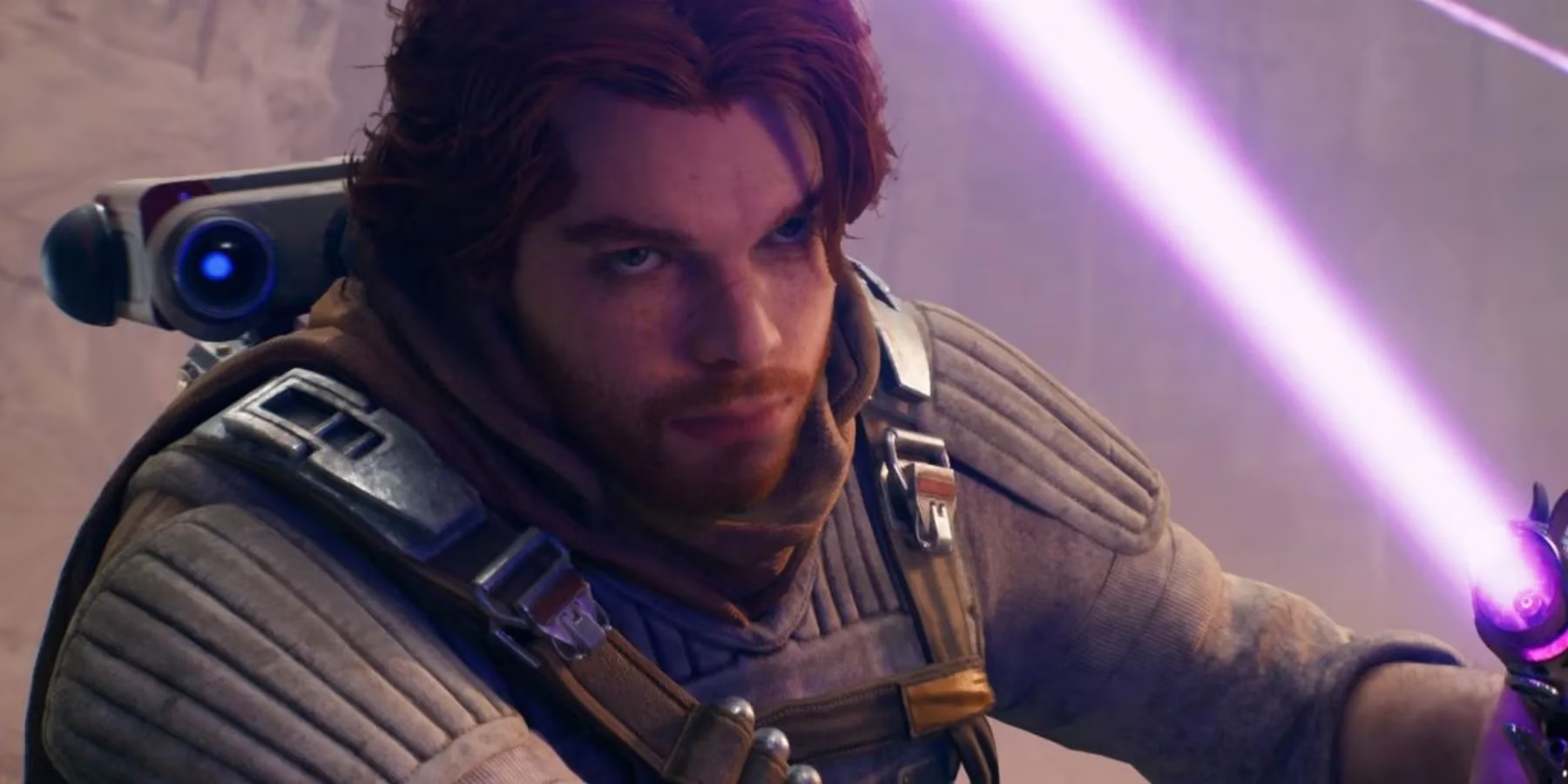
Look, I’ve spent more hours than I’d care to admit mashing that block button as Cal Kestis, navigating treacherous Imperial facilities, and awkwardly flirting with Nightsisters. By now, in 2026, the whole galaxy knows Cameron Monaghan has practically confirmed a third Star Wars Jedi game. But here’s the thing – between all the double-bladed lightsaber twirls and Force echoes that make Cal the galaxy's most empathetic archaeologist, one question keeps buzzing louder than a Kowakian monkey-lizard on a caffeine binge: what if Cal actually stumbles upon his biological family? And more importantly, how spectacularly would that violate everything those monastic, robe-loving Jedi ever taught him?
Let’s rewind a bit. The Jedi Order, in its infinite wisdom, had a habit of scooping up Force-sensitive toddlers before they could even form lasting memories of mom’s home-cooked Bantha stew. Attachment was treated like a severe allergic reaction; avoid at all costs. No birthday cards, no holocalls home – just meditation and a whole lot of repressing feelings. We all saw how that turned out for Anakin. Cal Kestis, though, has been coloring outside the Jedi lines since day one. He’s the guy who decided to destroy a Holocron holding the futures of Force-sensitive children not because some ancient text told him to, but because he actually cared more about their safety than the Order’s survival. Huge red flag for the traditionalist Jedi Council, enormous green flag for those of us who love a morally complicated protagonist.
Now imagine a scenario straight out of a holo-drama: Cal, still reeling from the chaos of Survivor, finally catches a whisper about his origins. Maybe it’s a hidden record on Bracca, or a Force vision triggered by another psychometric meltdown. He follows the trail not to a Sith lair, but to a modest dwelling on some forgotten Outer Rim world, where an aging couple – or perhaps a sibling – greets him with the one thing the Jedi could never offer: family. The sheer emotional whiplash of that moment would make the Trilla betrayal look like a friendly disagreement. We’re talking about a man raised in the sterile halls of the Order, suddenly confronted with the messy, glorious, and deeply personal connections that were stolen from him. It’s the ultimate narrative gut punch.
And what about Merrin? Survivor already teased a romance that would give any Jedi ethicist a migraine. Cal and Merrin’s bond is practically a neon sign reading “Attachment Happens.” Throwing his biological relatives into the mix cranks the tension to eleven. Anakin’s entire fall was catalyzed by his fear of losing Padmé; Cal is already juggling a relationship with a powerful Nightsister and a droid that has more personality than most senators. Adding parents to his roster of people to protect could either anchor him more firmly in the light or push him toward a path that’s neither Jedi nor Sith – a gray area that’s been whispered about in sourcebooks but never officially canonized in film or television. The developers could finally give us a playable, labeled Gray Jedi, a force-user who operates on a personal moral code rather than decrepit dogma.
I mean, think about the gameplay possibilities. A skill tree that branches based on emotional decisions rather than just light or dark points. Dialogues where you choose between saving a stranger or prioritizing your own flesh and blood. The series has already dabbled with Cal flirting with the dark side – his Force slow ability that chokes enemies in Survivor was disturbingly satisfying. A family reunion could be the catalyst for a completely new Force philosophy. Will Cal hand over his lightsaber and try to be a normal son? Unlikely. He’s more likely to wield his conflicted heart like a weapon, channeling both the serenity of the light and the passion of the dark into something uniquely his own. Imagine a final showdown where Cal spares a major antagonist not because the Jedi code demands mercy, but because his mom thinks violence is a bad look. That’s the kind of absurd, wonderful drama I’m here for.
Of course, this direction would ruffle the feathers of purists faster than a porg in an engine room. Some argue that Cal’s strength comes precisely from his isolation, that his found family – the Mantis crew – is already enough. Cere, Greez, Merrin, and BD-1 represent the family he chose, making the biological one obsolete. But I’d counter that the theme of inherited identity and healing generational wounds is ripe for exploration. Star Wars is built on the tension between destiny and choice. Cal accidentally rediscovering his parents would force him to choose, in real time, what kind of legacy he wants to uphold: the Jedi’s, his family’s, or his own.
The third game has a golden opportunity to deconstruct the very foundations of Jedi lore. Cal has never been a conventional pupil. He witnessed the Order’s failure firsthand, survived because of his scrappy reliance on friends, and rebuilt his sense of purpose around protecting people, not relics. Running into his family would be the ultimate test of that philosophy. Will he detach and walk away, honoring the code that ultimately failed his parents? Or will he embrace the mess, officially resign from the Jedi handbook, and create a new path that acknowledges love is not a weakness? Knowing Cal, he’ll probably do something reckless, heroic, and emotionally devastating. And I’ll be there, controller in hand, ready to sob into my galaxy-themed snack bowl. The future of Star Wars games looks luminous indeed, and I can’t wait to see how this particular Jedi continues to redefine what it means to be a keeper of the peace – family strings and all. 🚀
Comments