
In the vast tapestry of the Star Wars galaxy, planets often serve as grand stages for epic clashes, their identities shaped by the battles fought upon them. Yet, few worlds have endured a transformation as profound and tragic as Ilum. Once the most sacred site for Jedi younglings seeking their path, this frozen, Force-rich planet became a casualty of galactic tyranny, its story a silent scream echoing from a Jedi's first step to a superweapon's final blast. Its journey is a haunting reflection of the galaxy's own descent from light into darkness, a transformation as stark as watching a delicate snowflake be forged into the barrel of a cannon.
The Gathering: A Jedi's First Symphony
For millennia, Ilum was the heart of a Jedi's coming-of-age. Its core pulsed with rare, natural kyber crystals, attuned to the Force's energy like a galaxy's worth of heartbeats condensed into stone. Here, the ancient ritual known as the Gathering took place. Each year, guided by masters like Yoda, a handful of younglings—barely teenagers—would brave the planet's treacherous crystal caves. Their quest was deeply personal: to face their innermost fears and insecurities, and in doing so, find a single, living kyber crystal that resonated uniquely with their own Force signature. This moment was less like picking a tool and more like a soul recognizing its perfect harmonic counterpart in the universe's song. The chosen crystal was then entrusted to the ancient droid architect, Huyang, who would guide the young Jedi in constructing the lightsaber that would become an extension of their very being.

This tradition stood in stark contrast to the Sith's approach. Where Jedi sought harmony, Sith imposed domination. They used the Force to brutally bend a kyber crystal to their will, "bleeding" it and creating the iconic crimson blades—a violent scar upon the living stone.
The Empire's Scourge: From Sanctuary to Quarry
The fall of the Jedi Order with Order 66 marked the end of Ilum's age of light. The Empire, under Darth Sidious, saw not a sanctuary but a resource. Clone troopers swept the crystal caves, and soon after, Imperial mining operations descended upon the pristine world. The Jedi had taken only what was needed, in harmony with Ilum's ecosystem. The Empire enacted a policy of ruthless strip-mining, seizing millions of kyber crystals to power the ultimate terror: the Death Star's planet-destroying superlaser.
Their violation was not just subsurface. The Empire carved a massive, permanent trench along Ilum's equator—a black scar across the white flesh of the planet, as incongruous and brutal as a brand on a newborn's skin. This trench was a visible declaration of ownership and desecration.
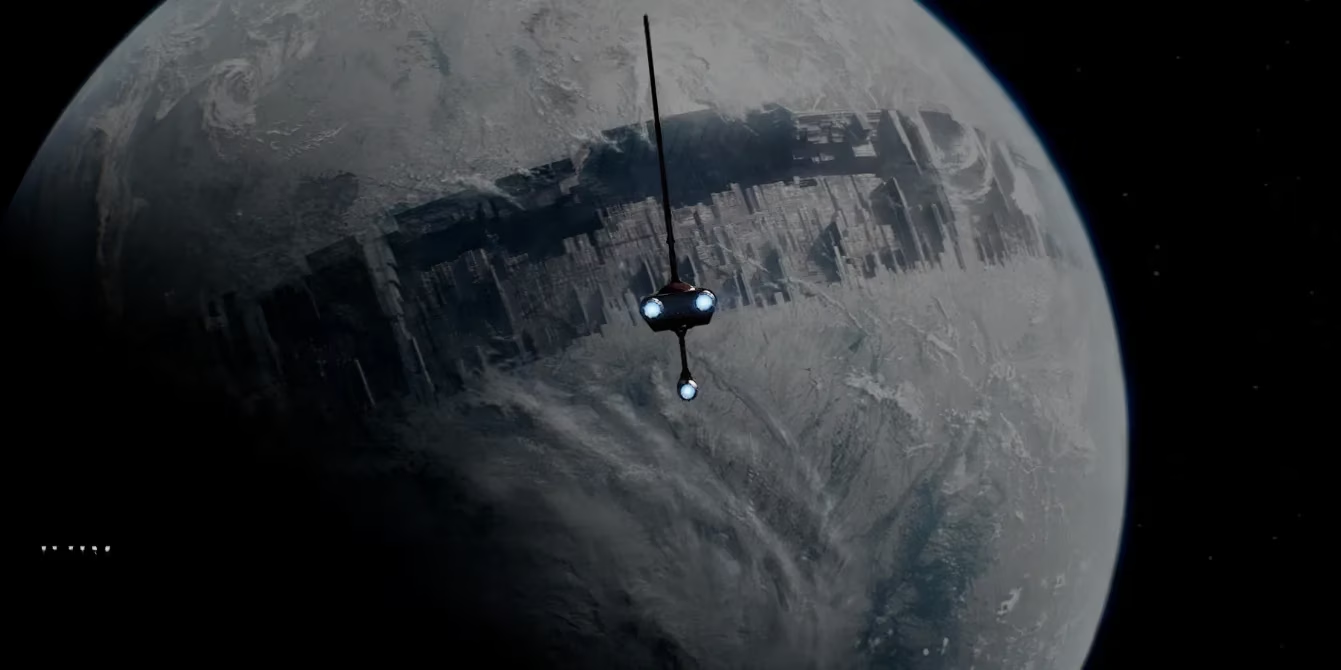
Years later, during the Dark Times, survivors like Cal Kestis would still brave Imperial patrols to reach Ilum's wounded heart, seeking to reconnect with the old ways and forge a new blade amidst the ruins of tradition.
The Final Abomination: Birth of the Starkiller
If the Empire wounded Ilum, the First Order murdered it. By 2026, the fascist remnant had taken the Imperial mining trench and transformed it beyond recognition. They engineered the ultimate perversion of Ilum's power, turning the entire planet into Starkiller Base. This superweapon didn't just use kyber crystals; it used Ilum's very core as a focusing array for a weapon that could drain stars and obliterate entire star systems from across the galaxy.
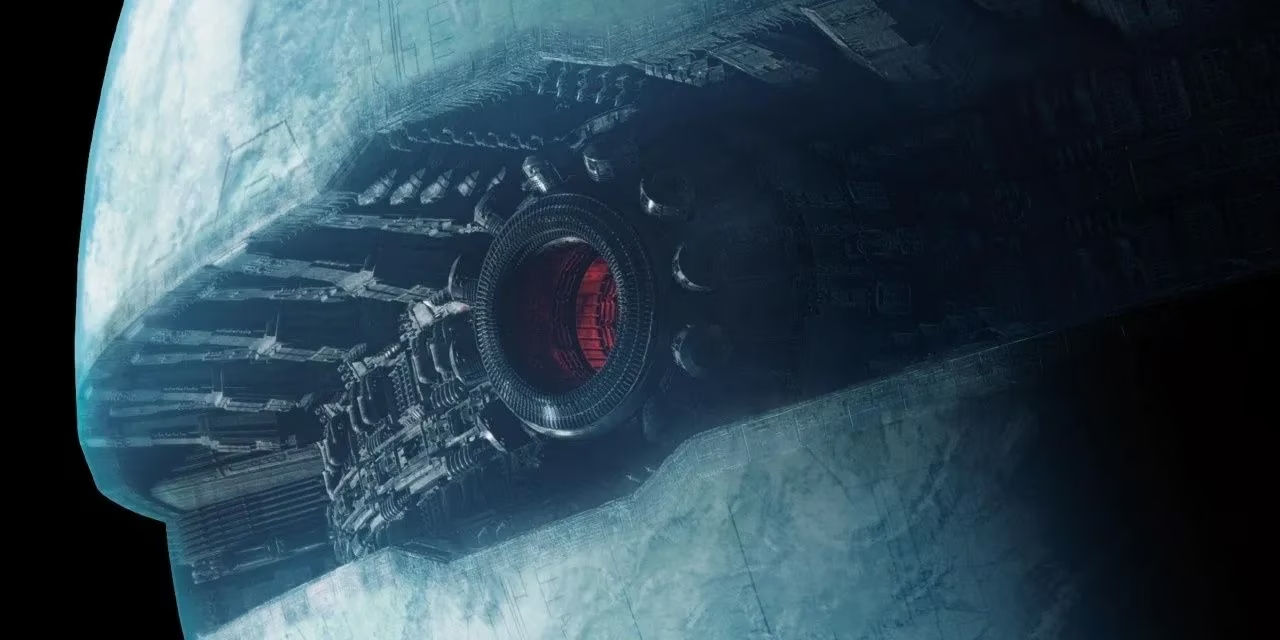
General Armitage Hux's fanatical pride in the weapon highlighted its terrifying scale. Its first test fire consumed the Hosnian system, shattering the New Republic. Ilum, the giver of life and purpose to generations of Jedi, had been forced to become an engine of apocalyptic death.
Solo: A Bitter Star of Remembrance
In a fitting act of poetic justice, the Resistance's heroic attack on Starkiller Base triggered a catastrophic chain reaction. The unstable weapon, fed by the planet's own ravaged core, detonated. Ilum was consumed, transformed from a world into a small, newborn star. The galaxy renamed it "Solo," in honor of the beloved smuggler who helped destroy the first Death Star.
Its fate is a profound tragedy. Ilum was an unsung victim, a world whose essence was harvested first for creation, then for terror. Its transformation from a Jedi's first trial to a fascist's final solution is one of the darkest arcs in galactic history. Now, the star Solo burns in the void—a luminous tombstone and a permanent, glaring reminder. It is a memorial to what was lost: a sacred place of becoming that was ultimately destroyed by the very forces it once helped the Jedi to fight. To look upon Solo is to see a silent scream made of light, a final, defiant spark from a world that was better off dying as a star than living as a weapon.
Comments