
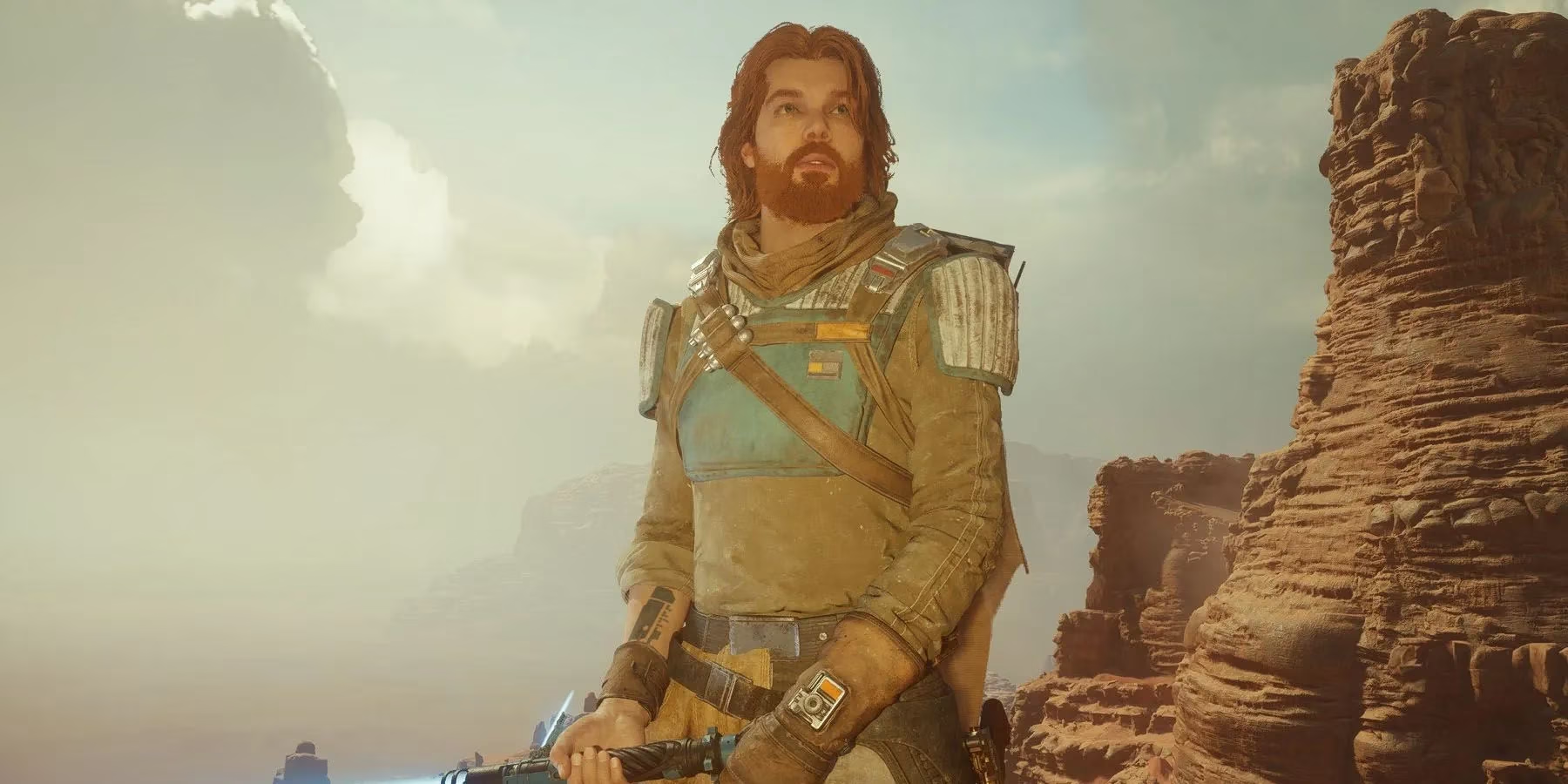
There are moments in gaming where a patch does more than simply smooth rough edges—it acts like a sonic resonator, amplifying a game’s hidden frequencies so that every player can finally tune in. Respawn Entertainment’s Star Wars Jedi: Survivor achieved exactly that with Update 8. Even now, orbiting the release in 2026, this patch remains a lodestar for what smart accessibility design looks like, proving that the path to the galaxy’s farthest reaches should never be blocked by invisible walls.
Since Cal Kestis ignited his second lightsaber adventure in April 2023, Jedi: Survivor has been a living, breathing artifact. Respawn didn’t just launch a tentpole Star Wars experience and move on—they treated the game like a kyber crystal, continually refining its facets through a stream of updates. Prior patches had already massaged creature animations, vanquished ray-tracing binocular bugs, and stabilized frame rates across PC and consoles. But Update 8, dropped back in January 2024, felt different. It was a deliberate pivot toward democratizing fear—and yes, I mean the delicious, palm-sweating terror of dueling a Rancor or parkouring across shattered Imperial platforms.
Let’s dissect this patch as if we were Cal examining a high-republic meditation chamber, because the three pillars introduced here remain touchstones for inclusive design in action epics.
🎨 High Contrast Mode: Painting the Galaxy in Narrative Neon
The first feature is something I’ve come to see as a chromatic compass. The new high contrast mode doesn't merely flatten colors or slather everything in a monochrome filter; it strategically desaturates the environment and then ignites specific hues to spotlight what matters. Narrative signposts, pick-ups, enemy silhouettes, and interactive elements suddenly glow like thermal bloom through a macrobinocular. Imagine playing Jedi: Survivor as if the world were a living tactical map, where every climbable wall shouts in brilliant cyan and every chest radiates a warm amber. This doesn’t just aid players with visual impairments—it alters the rhythm of discovery. For someone like me, who replays the game to savor every hidden Force Echo, the mode transforms the jungles of Koboh and the caves of Jedha into layered illustrations where each critical path hums with restrained light, like a constellation emerging from fog.
🔊 Audio Ping: Echolocation for the Force-Sensitive
Then Respawn did something that felt stolen from a Batarian myth—they granted us the power of active sonar within the Force. The new audio ping functionality lets Cal emit a pulse that passively and actively maps the immediate area through sound. Stand still, and softer pings passively whisper the direction of nearby databanks or stim canister shards. Trigger a manual ping, and the environment speaks back in a staccato of directional audio cues, revealing interactable objects as if Cal were a humanoid moth clicking into the dark. For players navigating without visual references, this is game-changing. For sighted players, it’s an extra sensory feather in your utility belt—I’ve used it to locate hidden doorways behind vines that my eyes had skimmed over a dozen times. It’s like strapping a sonic lighthouse to your back, turning exploration into a co-operative duet between ear and instinct.
🐢 Slow Motion Presets: Breathing Room for Every Blade Parry
Combat in Jedi: Survivor is a violent waltz, but not everyone can match the tempo of a crossguard stance swing or the frantic blaster-bolt parry sequences. Update 8 didn’t just keep the existing slow motion toggle; it delivered three precise presets at 30%, 50%, and 70% of normal speed, accessible from a redesigned shortcut menu. Think of these presets as a personalized rhythm engine. At 30%, every duel becomes a choreographed ballet where you can study an enemy’s wind-up like a scholar reading ancient texts. At 50%, the combat maintains tension but gives you that extra heartbeat to react. At 70%, it’s just enough lubrication for the mind to plan a sequence without feeling disconnected from the action. I’ve watched players who once bounced off the game’s difficulty now weave through entire Imperial facilities with grace, their frustration replaced by the same laser-focused calm that Cal reaches in battle meditation.
The patch didn’t stop at features—it quietly mended the game’s skeleton. Performance and stability fixes rolled out for all platforms, chipping away at frame drops that used to ambush players during the sweeping vistas of the Shattered Moon. These weren't flashy additions, but they were the connective tissue that let the accessibility features function without compromise. A high contrast mode stutters if the rendering pipeline buckles; an audio ping loses its magic if sound threads crash. The holistic care here signals a studio that understands accessibility as an ecosystem, not a checklist.
🌌 Looking Forward from 2026: The Legacy of Update 8
Two years later, the ripples of Update 8 are still traveling through the galaxy. As I write this in 2026, the rumored third Star Wars Jedi game is gestating inside Respawn’s workshops, teased by job listings and Cameron Monaghan’s sly winks. The foundation laid by Survivor’s post-launch support—culminating in this eighth patch—has become a template. Other developers now cite the audio ping and high contrast mode in GDC talks, proving that Cal Kestis’ journey isn’t just a story about rebuilding the Jedi Order, but about rebuilding the very philosophy of who gets to be a hero in digital spaces.
Looking back, Update 8 wasn’t a massive content drop. There were no new planets, no additional lightsaber stances. Yet it expanded the galaxy more tangibly than a new star system could. It told players, loud and clear: “We see you. We hear you. Now come feel the Force on your own terms.” That, to me, is a truer form of Jedi wisdom than any holocron could store.
Whether you are a Padawan taking your first steps in the Coruscant underworld or a weathered Force Master mining every corner for collectibles, the tools packaged in this update remain your faithful astromech. They whisper orientation when you’re blind in the Spires, slow time when a Ninth Sister’s flurry overwhelms, and paint salvation in colors only you can read. In the ever-expanding Star Wars galaxy, Jedi: Survivor Update 8 is that steady, guiding binary sunset—a beacon that ensures no wanderer is left in the dark.
Key accessibility features introduced in Update 8:
| Feature | Description |
|---|---|
| High Contrast Mode | Desaturates the environment and uses specialized colors to highlight narrative and gameplay elements |
| Audio Ping | Enables passive and active echolocation of nearby objects and interactables via sound cues |
| Slow Motion Presets | Three new speed presets (30%, 50%, 70%) to customize combat and exploration pace |
Even as we race toward 2027 with next-generation engines and haptic suits, sometimes the most powerful upgrade is the one that simply opens the door a little wider. May the Force—and smart design—be with us all.
Comments